
From train drivers to digital legacies: a short history of the dead man’s switch
The idea behind automated inheritance is more than a century old. It began with a handle on a locomotive — and it still answers the same question: what should happen if the person in charge stops responding?

A dead man’s switch is a mechanism that triggers an action when a person stops actively confirming they are present. It originated in rail and tram transport, where a driver had to keep pressing a control or the brakes would apply. Digital inheritance services use the same logic: you confirm periodically that you are fine, and if you stop, pre-arranged information is released to people you chose.
- The dead man’s switch was designed for safety, not for drama: assume silence means trouble.
- The same principle now protects families: periodic confirmation, then a predefined action.
- Good switches are tolerant: reminders, grace periods and a safe path for false alarms.
- In digital inheritance, the “brake” is the secure release of exactly what you prepared — no more.
Picture an early electric tram. The driver stands at the controls with one hand on a handle that must be held down. If the driver faints, the handle springs up and the brakes engage. Nobody has to notice that something went wrong: the absence of a signal is the signal.
That small piece of engineering — the dead man’s switch — is the ancestor of a whole family of systems we use today without thinking about them. It is also the most honest answer to a question every family eventually faces: what happens if the person who holds everything together can no longer act?
Silence as information
The brilliance of the original idea is its inversion. Most alarms wait for something to happen. A dead man’s switch waits for something to stop happening. Railways later refined it into vigilance systems that ask the driver to acknowledge a signal at intervals; a missed acknowledgement triggers a warning, then an automatic stop.
Notice the two-stage design: first a reminder, then an action. It is the difference between a system that is safe and one that is merely strict.
From machines to information
As our lives moved online, the same question appeared in a new form. What happens to an email account, a photo library or a crypto wallet when its owner stops logging in? Large platforms began offering “inactive account” settings that act after a period of silence. These are useful — but each covers only its own walled garden.
An estate does not live in one garden. It lives in banks, brokers, cloud drives, drawers, hardware wallets and people's heads. The dead man's switch needed to grow up.
What a good modern switch looks like
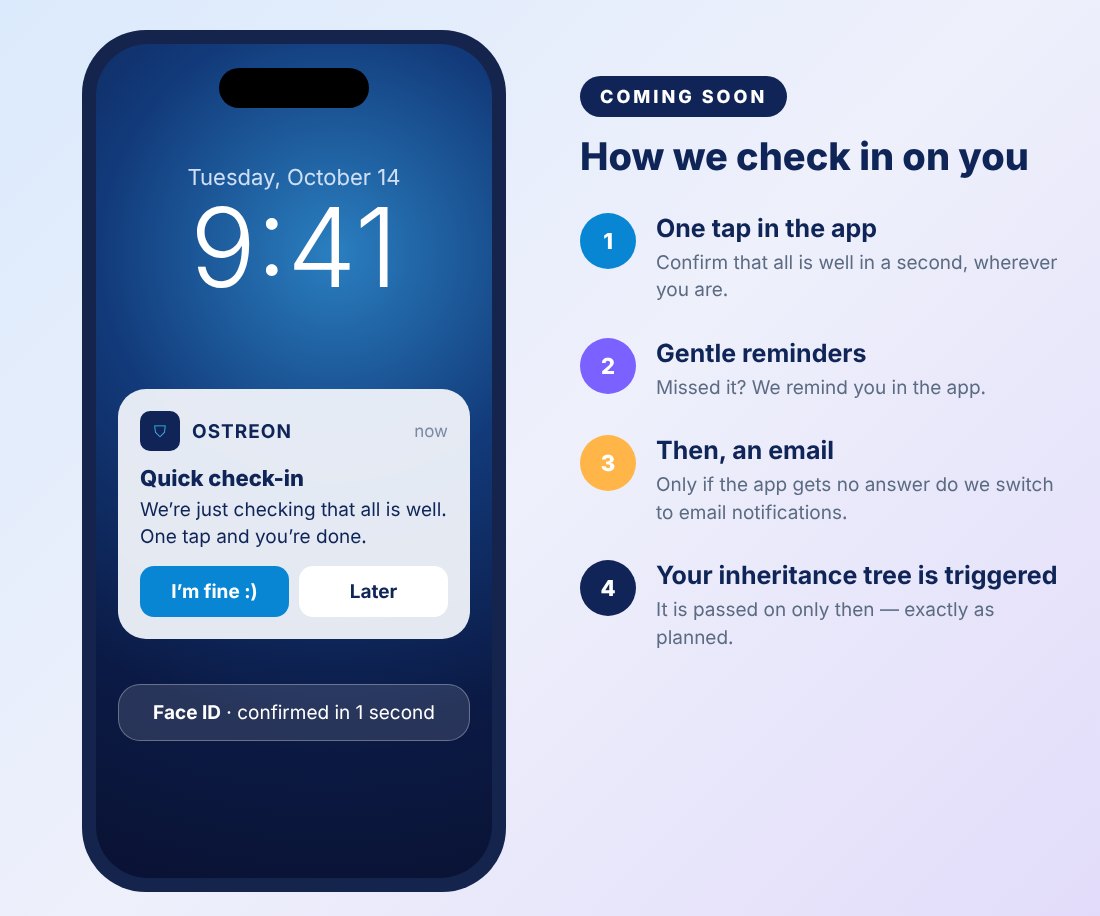
A good switch doesn’t ask “are you dead?”. It asks “are you still here?” — gently, and more than once.
Why this matters more than a will
A will is a legal instruction executed after death has been established. A switch is an operational mechanism that works before the paperwork starts — the moment when families are most lost. The two are complementary, as we explain in A will says who. It doesn’t say where..
The dead man’s switch, rebuilt for families
OSTREON works like a modern dead man’s switch. You choose a rhythm — every 7, 14, 30, 45, 60 or 90 days (30 by default) — and confirm in one click. Miss one, and we remind you every day until you respond or until the protection delay you set runs out.
A few days before your first beneficiary, you get emergency access. Only then are your beneficiaries notified, each receiving only the assets you assigned them. Today the check-in arrives by email; app and SMS notifications are coming soon.
Start your free month →Frequently asked questions
What is a dead man’s switch?
A mechanism that triggers an action when a person stops actively confirming they are present. It was first used in trains and trams, where releasing a control applied the brakes.
How is a dead man’s switch used in digital inheritance?
The owner confirms at regular intervals that they are fine. If confirmations stop, reminders follow, and after a defined delay pre-arranged information is securely released to chosen beneficiaries.
What if I miss a check-in because I’m on holiday or ill?
A well-designed switch is forgiving: OSTREON sends daily reminders and applies a protection delay you choose, and gives you emergency access before any beneficiary.
How often does OSTREON ask me to confirm?
You choose: every 7, 14, 30, 45, 60 or 90 days. New accounts start at 30 days and you can change it at any time.
This article is general information, not legal, tax or financial advice. Rules differ by country and change over time — check with a qualified notary, lawyer or adviser for your situation.