
Sharing documents with your financial advisor — without leaking them
Advisors need your statements, deeds and tax returns. Email is the default channel, and it is a poor one. A practical guide for clients and advisors to exchange sensitive files safely.

To share sensitive documents with a financial advisor safely, avoid email attachments and consumer file links; use an encrypted channel with access control and expiry, share only what is needed for the task, keep the originals in your own vault, and approve any changes the advisor proposes to your records. Advisors should offer such a channel by default — it protects them as much as their clients.
- Share the minimum, for the minimum time.
- End-to-end encryption and expiring access beat email attachments and open links.
- Keep the master copy in your own vault — not in the advisor’s inbox.
- Approval-based collaboration: the advisor suggests, you decide.
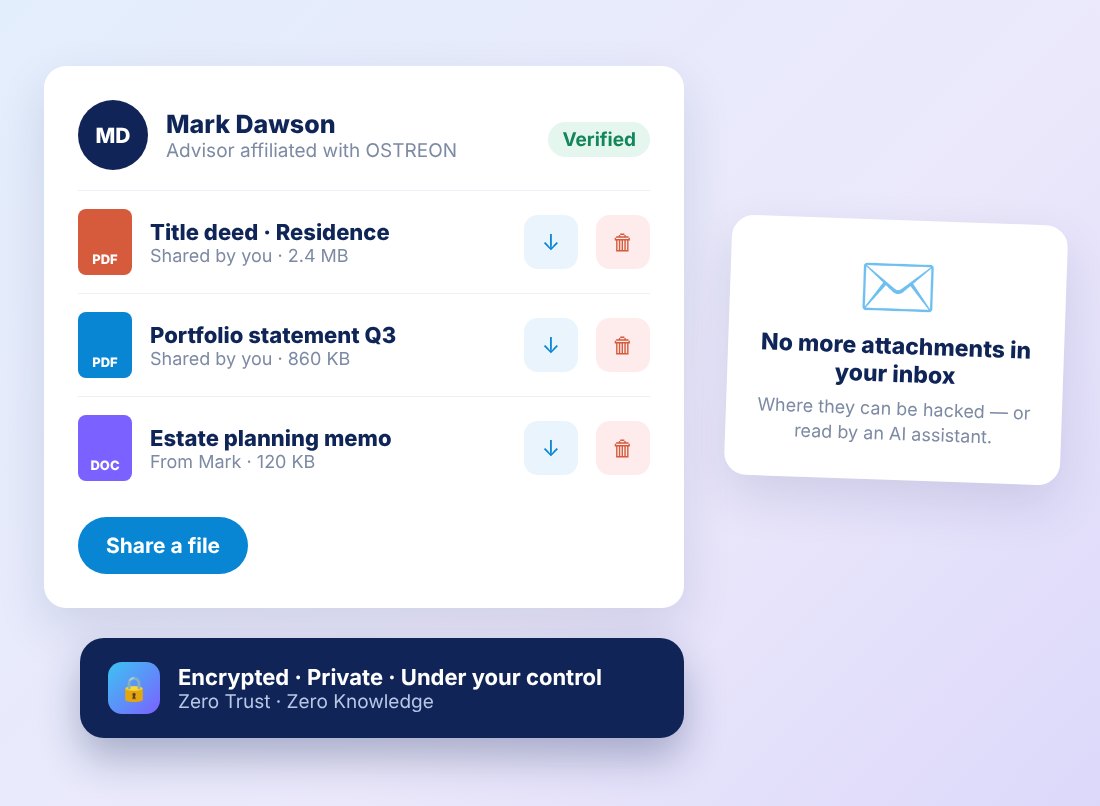
A good advisor relationship runs on documents: account statements, title deeds, tax returns, insurance contracts, company accounts. Most of them still travel by email — and live forever in two inboxes, two sets of backups and, increasingly, within reach of AI assistants connected to those inboxes. We explained why in Your inbox is not a safe.
Four principles
 Least privilegeShare only the documents needed for the current task — not the whole folder.
 Time limitsAccess that expires when the work is done.
 Encryption end to endThe platform carrying the file shouldn't be able to read it.
 ApprovalChanges to your records only after you confirm them.
For clients: a checklist
- Ask your advisor which secure channel they use. If the answer is “email”, propose an alternative.
- Never send identity documents or full statements as plain attachments.
- Keep originals in your own encrypted vault, organised by asset.
- Review who has access to what, and revoke what's no longer needed.
For advisors: a checklist
- Offer an encrypted, access-controlled channel by default.
- Limit what you store: once a document has served its purpose, ask whether you need to keep it.
- Separate client data from your mailbox and from tools that aren't designed for it.
- Document your process — it is a selling point, and regulators increasingly ask.
Your advisor helps. You approve.
If you were referred by one of OSTREON's partner advisors, you choose what to share — by asset, by beneficiary, down to a single field. You can grant edit rights, but every change your advisor proposes waits for your approval before it becomes part of your inheritance tree. Files are exchanged through our Zero Trust, Zero Knowledge channel, with time-limited access. Nothing lands in an inbox.
Start your free month →Advisors: see For advisors: the great wealth transfer is a retention problem — here’s how to solve it.
Frequently asked questions
Is it safe to email documents to my financial advisor?
It is risky: attachments remain in several inboxes and backups for years, and mailboxes are frequent targets. Use an encrypted, access-controlled channel with expiring access.
What should I look for in a secure document-sharing tool?
End-to-end encryption, granular sharing (only what is needed), time-limited access, an audit of who can see what, and the ability to revoke access.
Can my advisor edit my OSTREON account?
Only if you grant edit rights, and every change they propose requires your approval before it becomes part of your inheritance tree.
How does OSTREON share files with advisors?
Through a Zero Trust, Zero Knowledge channel with time-limited access, so files are not left in email inboxes.
This article is general information, not legal, tax or financial advice. Rules differ by country and change over time — check with a qualified notary, lawyer or adviser for your situation.