Your inbox is not a safe
We email passports, deeds and bank statements without a second thought. Here is why the mailbox is one of the worst places to keep your family’s most important documents — and what to do instead.
Email was designed to deliver messages, not to store secrets. Attachments stay in sent folders, recipients’ inboxes and backups for years; accounts get breached; forwarding rules can be silently added; and AI assistants connected to a mailbox can read what is inside. Sensitive estate documents should live in an encrypted vault and be shared through time-limited, access-controlled channels instead.
- An email attachment exists in at least two inboxes, often many more — and rarely gets deleted.
- Mailbox compromise is one of the most common entry points for fraud.
- AI assistants connected to email can read attachments; that changes the threat model.
- Use an encrypted vault for storage and time-limited sharing for exchange.
Here is a small experiment. Search your own mailbox for “passport”, “statement”, “deed” or “tax return”. Most people find dozens of results, some a decade old, sitting in sent folders and old threads. Each of those attachments is also sitting in somebody else's inbox — your accountant's, your notary's assistant's, a former employer's HR department.
We treat email like a filing cabinet. It is closer to a postcard rack.
Four reasons the inbox fails as a vault
1. Copies multiply and never die
Every attachment you send exists in your sent folder, the recipient's inbox, both providers' backups, and any device that synced the message. You can delete your copy; you cannot delete theirs.
2. Mailboxes are the front door for fraud
A compromised mailbox lets an attacker read years of documents, reset passwords for other services and impersonate you to your bank, your advisor or your family. Silent forwarding rules can leak new mail for months before anyone notices.
3. AI assistants now read your mail
More and more people connect AI assistants and productivity tools to their email so they can summarise and search it. That is convenient — and it means every document in that mailbox is now readable by another system, with its own permissions and its own risks.
4. Your family can’t use it anyway
Ironically, the inbox fails at inheritance too. Even if every important document is in there somewhere, your heirs usually cannot log in — and if they can, they face 40,000 messages and no index.
Email is a delivery service. Nobody stores the family jewels in the post office.
What to do instead
- Store originals in an encrypted vaultOne place, organised by asset, encrypted before upload.
- Share with professionals through time-limited linksYour advisor gets what they need for as long as they need it — then access ends.
- Clean up the pastSearch your mailbox for sensitive attachments and delete what you no longer need. Ask regular correspondents to do the same.
- Protect the mailbox you keepStrong unique password, two-factor authentication, and a periodic check of forwarding rules and connected apps.
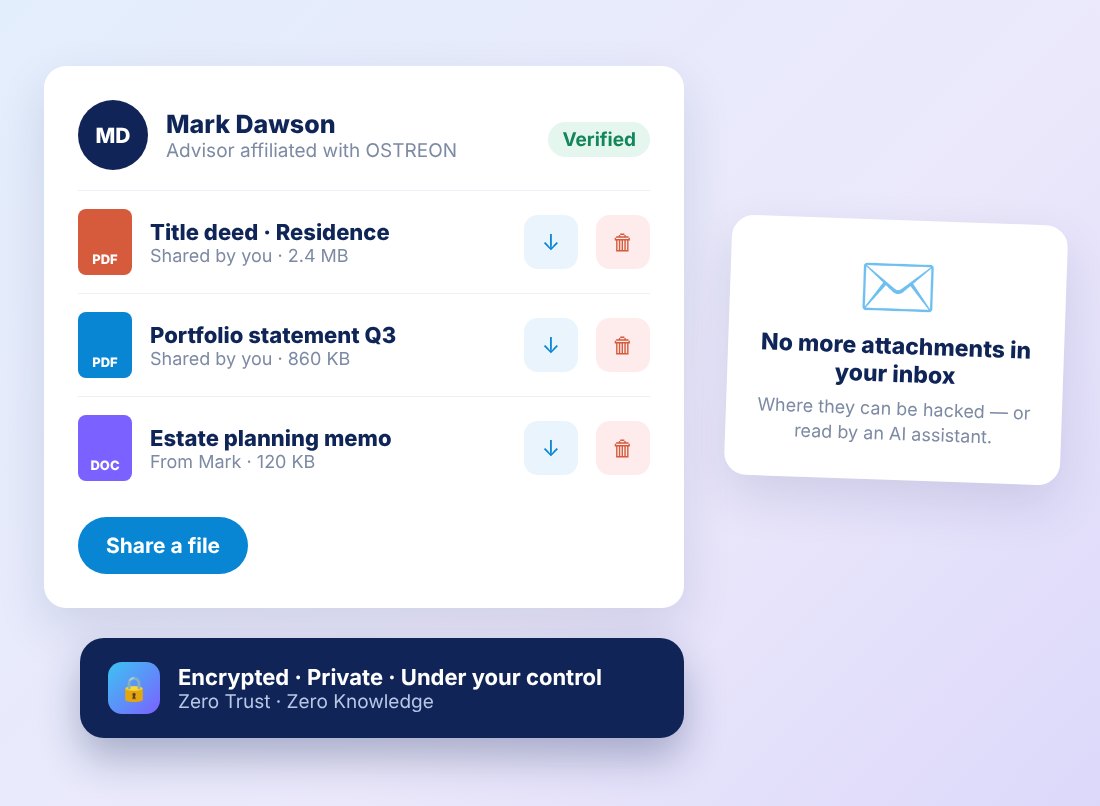
No more attachments in your inbox
OSTREON stores your documents with the asset they relate to, encrypted on your device. When you work with an advisor, files are exchanged through our Zero Trust, Zero Knowledge channel with time-limited access — and you approve every change they suggest. Nothing lingers in a mailbox, and nothing is readable by an assistant you didn't invite.
Start your free month →For advisors and their clients, we go deeper in Sharing documents with your financial advisor — without leaking them.
Frequently asked questions
Is it safe to send identity documents by email?
It is risky. Attachments remain in several inboxes and backups for years, mailboxes are frequently compromised, and connected tools can read them. Use an encrypted, access-controlled channel instead.
Can AI assistants read my email attachments?
If you connect an AI assistant or productivity tool to your mailbox, it may be able to read and process messages and attachments, depending on the permissions you granted. That is one more reason to keep sensitive documents out of email.
Where should I keep important estate documents?
In an encrypted vault organised by asset, with controlled sharing for professionals and automatic, beneficiary-specific release for your family — the model OSTREON follows.
How do I share documents securely with my financial advisor?
Use a channel with end-to-end encryption and time-limited access rather than email attachments. OSTREON’s advisor sharing works this way, and every change requires your approval.
This article is general information, not legal, tax or financial advice. Rules differ by country and change over time — check with a qualified notary, lawyer or adviser for your situation.