
How to choose a guardian for your children: a decision guide
It’s the hardest name to write down. A structured way to choose who would raise your children — and who would manage what they inherit — with the questions to ask, the conversation to have and the backups to plan.

To choose a guardian, start from your children’s needs, then assess candidates on values, relationship with the children, age and health, stability, location, family situation and willingness. Consider separating the guardian who raises the children from the person who manages their inheritance. Talk to your chosen people before naming them, name at least one backup, record the choice in the form your law requires (for example in a will — in France, by will or a special declaration before a notary, Civil Code art. 403; in England and Wales, in writing under the Children Act 1989, s. 5), and write a letter explaining your wishes.
- Start from your children’s needs, not from family expectations.
- Raising a child and managing their money can be two different jobs for two different people.
- Always ask before naming — and always name a backup.
- Use the legal form your country requires, then add a personal letter for the guardian.
Parents put off this decision more than any other. It forces you to imagine your absence, and it can feel like ranking the people you love. But if both parents die without naming anyone, a court or family council will decide — without knowing your children as you do. The decision is hard; not making it is harder on them.
Step 1 — Start with your children
Before thinking about candidates, write down what your children need: stability, staying in the same school, closeness to grandparents, faith or values, support for a health condition, keeping siblings together. The right guardian is the person who best meets those needs.
Step 2 — Assess the candidates
| Criterion | Questions to ask yourself |
|---|---|
| Values & parenting | Would they raise my children in a way I'd recognise? |
| Relationship | Do my children know and trust them? |
| Age & health | Could they realistically care for a child until adulthood? |
| Stability | Home, relationship, work — could they absorb one or more children? |
| Location | Would my children have to change country, language or school? |
| Their own family | How would their partner and children feel? |
| Willingness | Have they said yes, freely? |
Don't rule out the best carer because they can't afford more children — your estate, insurance and a separate financial manager can solve that (Life insurance: the beneficiary clause is the real will).
Step 3 — Split the roles if it helps
Separating the roles protects the guardian from financial pressure and the child from conflicts of interest.
Step 4 — Have the conversation
- Ask, don't announce. Give them time to think and discuss it with their family.
- Share your hopes and the practical realities (schools, health, finances).
- Agree on what happens if their situation changes.
Step 5 — Make it legal, then make it human
- Use the required formIn France, the last surviving parent with parental authority can choose a guardian by will or by a special declaration before a notary (Civil Code art. 403). In England and Wales, a parent with parental responsibility can appoint a guardian in writing (Children Act 1989, s. 5). In the US, guardians are usually nominated in a will and confirmed by a court.
- Name backupsAt least one alternate, in case the first choice can't act.
- Write a letter to the guardianRoutines, health, people who matter, your hopes (The letter of wishes: the most human document in your estate plan).
- Review every few yearsPeople's lives change — so do children's needs (The annual legacy check-up: a 20-minute ritual).
Name the guardian where it actually matters
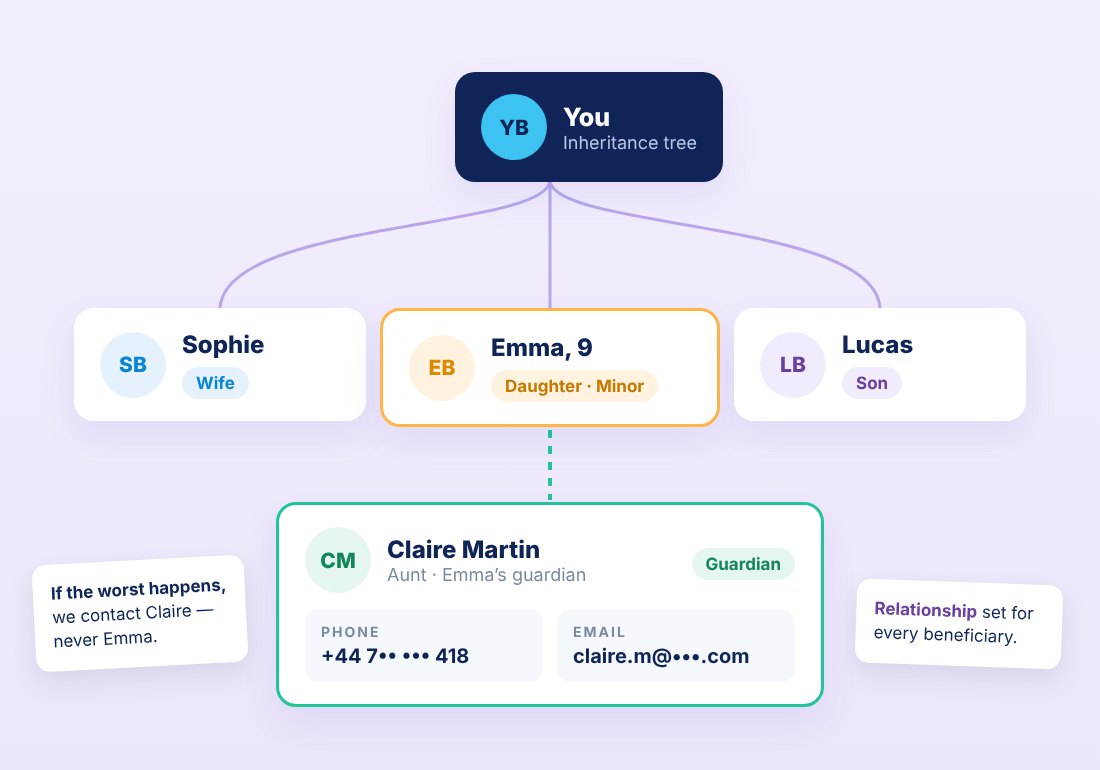
In OSTREON's inheritance tree, you mark each minor and assign a guardian with their contact details. We never contact a minor directly: if the inheritance is triggered, the guardian receives the information, documents and messages you prepared for the child's assets — including your letter to them. Store your will or notarial declaration in the dedicated section so the legal appointment and the practical information arrive together.
Start your free month →Already named as a guardian? Read Named as a guardian: a handbook for managing a child’s inheritance.
Frequently asked questions
How do I choose a guardian for my children?
Start from your children’s needs, then weigh candidates on values, relationship with the children, age and health, stability, location, family situation and willingness. Ask them first and name a backup.
How do I legally appoint a guardian?
It depends on the country: in France, by will or a special declaration before a notary (Civil Code art. 403); in England and Wales, in writing (Children Act 1989, s. 5); in the US, usually by nomination in a will confirmed by a court.
Should the guardian also manage my children’s money?
Not necessarily. Many parents separate the person who raises the children from the person or structure that manages their inheritance.
What happens if I don’t name a guardian?
A court or family council, depending on the country, will appoint one — without necessarily knowing your wishes.
This article is general information, not legal, tax or financial advice. Rules differ by country and change over time — check with a qualified notary, lawyer or adviser for your situation.